
Instructions
These Questions simulate take-home technical assessment at many startups. In actual interview, you’ll typically have 1-2 hours.
- Assume designs are for mass production. Cost, assembly, and reliability needs to be considered.
- Include simple sketches and explain assumptions and reasoning for context. Try to show your work. It’s important to show your problem-solving process.
- email your answer to admin@lowinertia.com if interested in a personal feedback.
Good luck!
Question 1 - First Principle Analysis
There is a water-filled chamber with two hot plates directly beneath it, each equipped with its own cartridge heater and thermistor for independent temperature control. In order for certain reactions to happen, the chamber needs to have an area between 31±1C and 88±1C.
Assumption: Uniform and correct temperature in the hot plates. Only consider steady state. Don’t worry about the initial heating. The chamber is made out of acrylic.
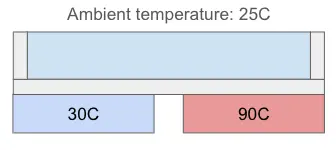
- Draw a simple sketch of what you would expect the temperature gradient to look like at steady state
- Draw a simple sketch of what you would expect the zone of 32±1C and 88±1C would be located.
- What would happen if the chamber was made out of the following materials instead?
- In real life without making any assumptions, what can go wrong in this design? How would you mitigate it?
- How would you optimize this design to maximize volume of 32±1C and 88±1C zones.
Question 2 - System Architecture & Design Review
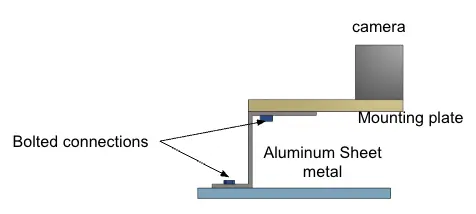
A FLIR Camera (29 mm x 29 mm x 39 mm / 53 g) need to be mounted in a raised surface for optimal field of view.
Please perform a comprehensive design evaluation of the system illustrated in the image below:
- Strengths & Weaknesses Analysis
- Requirements & Information Gathering
- Second-Order & Downstream Effects
Question 3 - Automated Precision Clamping Fixture Design
Problem Statement: We are developing a future prototype that requires a custom clamping fixture to bond an assembled consumable component to a flat lower plate. The bottom component in organe is a thin, flexible film.
Due to height variation and the inherent flexibility of the film, the adhesive gets drawn into an unintended region (indicated by the red box) during cure. This adhesive creates a local peak that that is unacceptable for downstream processing.
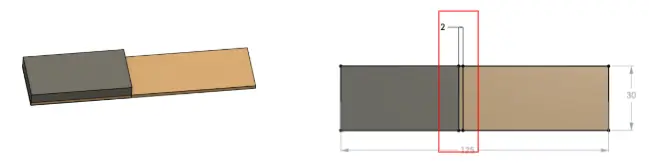
Task: Propose a fixture design and mechanism that delivers uniform clamping pressure across the interface to eliminate adhesive migration while meeting the operational requirements below.
Key Technical Requirements:
- Nominal Pressure: Apply a target pressure of 15 PSI evenly across the full 1.0 sq. in. contact area.
- Pressure Distribution: Maintain a strict pressure gradient tolerance of < 2 PSI across the entire bonded surface.
- Thermal Cycling Durability: System components and actuation mechanism must withstand 1,000,000 thermal cycles between 22°C and 70°C without performance degradation, material failure, or loss of calibration.
Deliverables:
- Proposed mechanical concept(s) for clamping that achieve sub-2 PSI gradient over flexible media.
- Actuation / release concepts (e.g., pneumatic, electric servo, voice coil) optimized for high cycle life.
- Key design considerations or failure modes to mitigate during detailing.