project-highlight-image

Stampede Sky - Flight Simulation and Modeling Lead

Led the development of a six-degree-of-freedom (6-DOF) flight dynamics simulation for a next-generation medium-haul aircraft. Directed a small team of engineers and defined the simulation architecture and validation methodology for a 40-person senior capstone project. Established model fidelity by analyzing stability derivatives of a Boeing 747-200 in cruise and benchmarking its dynamic response against textbook data. The validated derivatives were implemented in a SIMULINK based 6-DOF simulation framework to evaluate handling qualities and simulation boundaries. This tool provides quantitative feedback to inform future aircraft design iterations and control system development. This experience reinforced my ability to apply theoretical flight dynamics knowledge in conjunction with reference aircraft data to guide decisions on how an aerospace vehicle should behave.
Home
Questions?
hero-image

Madhav Bhattarai

Project Timeline

Feb 2025 - Current

HighlightS

  • Conducted a design analysis on morphing wing technology, found 6% increase in aerodynamic efficiency during off-design conditions such as take off and landing.
  • Achieved a phugoid-mode error within 15% and short-period mode error within <1% of referenced textbook values.
  • Achieved key lateral dynamic modes within 12% of textbook values.
  • Developed a 6-DOF SIMULINK model using stability derivatives obtained from OpenVSP to validate model fidelity to simulate the full-scale conceptual aircraft.

SKILLS

MATLAB
Simulink
OpenVSP
SolidWorks
FlowSimulation
DataVisualization

External Links

Problem Statement

Our team was tasked with conducting a preliminary design study for a next-generation medium-haul transport aircraft, targeting efficiency improvements of 30-50% in passenger nautical miles per gallon (PNMpg) over today's single aisle fleet through configuration, aerodynamics, and controls innovation. The main design innovation we decided on was the retracting canard technology, which is used to reduce parasite drag during cruise. My primary work thus far consists of analyzing the morphing wing technology for further improvements and serving as the lead for our simulation and modeling cross-functional team.
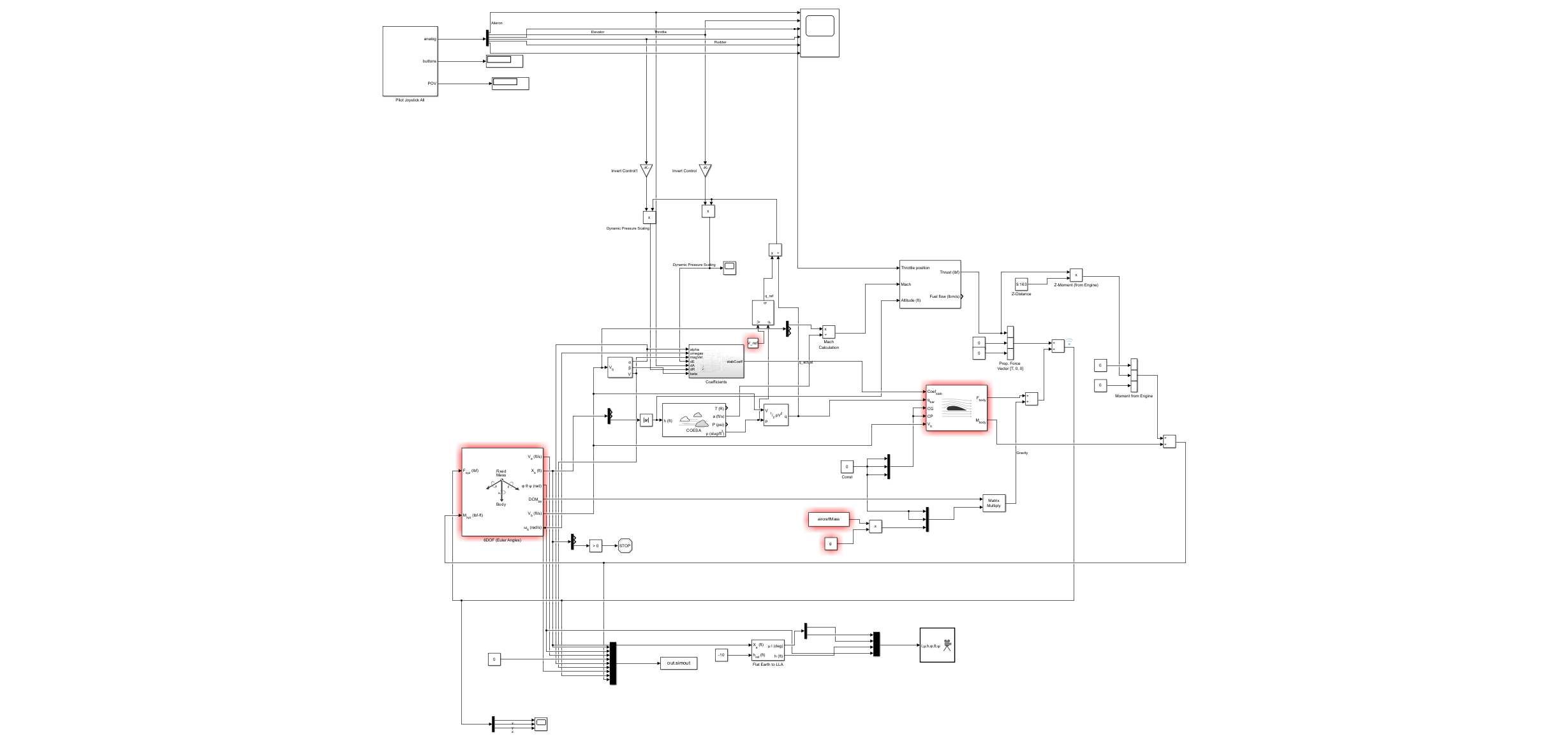
Pasted image

Shown above is the simulation architecture. It takes in the aerodynamic forces and moments of our model and simulates its state using the 6-DOF block. The simulation can be visualized in FlightGear.