


📌 Project Overview
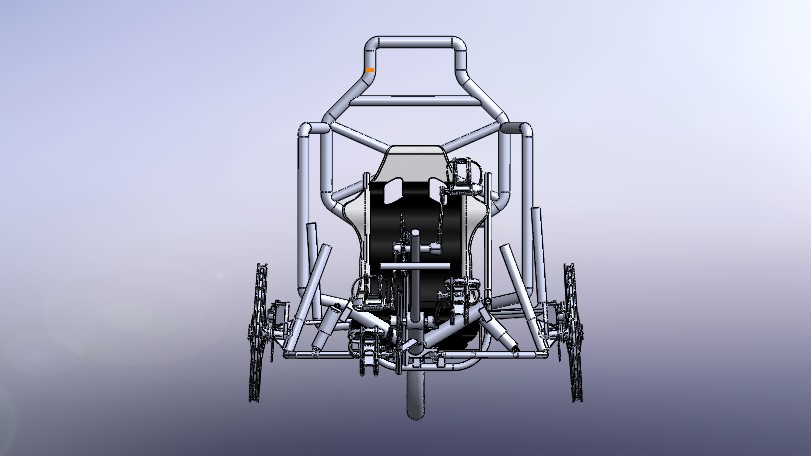
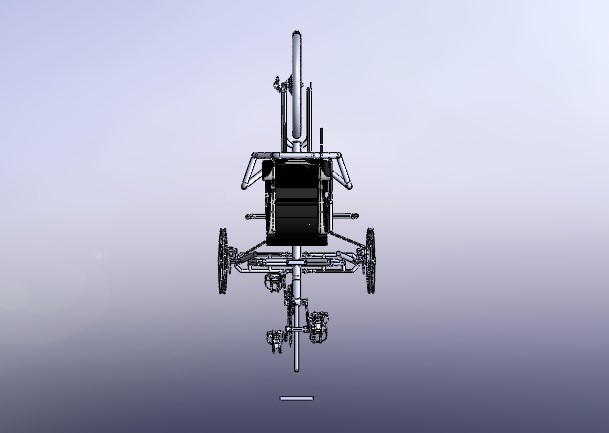
Designed, analyzed, fabricated, and validated a tadpole-configuration Electric Human Powered Vehicle (EHPVC) for the ASME E-FX Competition. The vehicle integrated pedal-powered dynamics with an auxiliary electric drive system, developed to meet performance, manufacturability, and competition constraints.
👤 Role & Responsibilities
- Team Captain, Design Lead, and Fabrication Lead – responsible for complete CAD modeling, structural and aerodynamic analysis, and leading the chassis fabrication.
- Coordinated team efforts across design, welding, sourcing, and integration of power systems and drivetrain.
🖥️ Design & CAD Development
-
Modeled the entire vehicle using SolidWorks, incorporating ergonomic considerations, RPS (Roll Protection System), and tadpole (two front wheels + one rear) geometry.
-
Integrated a 500W hub motor on the rear wheel and a 13,000 mAh battery pack to support hybrid human-electric operation.
-
Balanced stability, ground clearance, and weight distribution to optimize handling.
⚙️ Finite Element Analysis (FEA)
-
Conducted structural FEA on the chassis and Roll Protection System (RPS).
-
Minimum required load capacity: 2800 N | Achieved: >5000 N, ensuring compliance with competition safety factors.
-
Optimized weld joints and tubing curvature to align fabricated structure with FEA predictions.
🌬️ Computational Fluid Dynamics (CFD)
-
Performed aerodynamic simulations to analyze drag and lift characteristics.
-
Results: Lift coefficient (Cl) = 0.1, Drag coefficient (Cd) = 4.69.
-
Proposed addition of a front windshield for drag reduction, but implementation was constrained by time.
🛠️ Fabrication
-
Led fabrication activities including welding of the chassis and RPS, ensuring geometrical accuracy for structural integrity.
-
Outsourced critical drivetrain and rolling components (wheels, chain, crankset, etc.) from bicycle suppliers.
-
Key challenge: achieving precise weld curvature on the RPS to preserve FEA-validated load paths.
🔋 Testing & Validation
-
Conducted trials for battery consumption, charging cycles, and drivetrain dynamics.
-
Identified practical issues such as chain slack, DFM-related adjustments, and ride stability vs. ground clearance.
-
Despite minor operational inefficiencies, the vehicle successfully met competition criteria.
🏆 Outcome & Achievements
-
Secured 1st Place in the ASME E-FX Competition.
-
Validated complete product development cycle: CAD modeling → FEA/CFD → fabrication → testing.
-
Gained hands-on expertise in DFM, vehicle dynamics, drivetrain integration, and structural welding practices.
--
.png)