


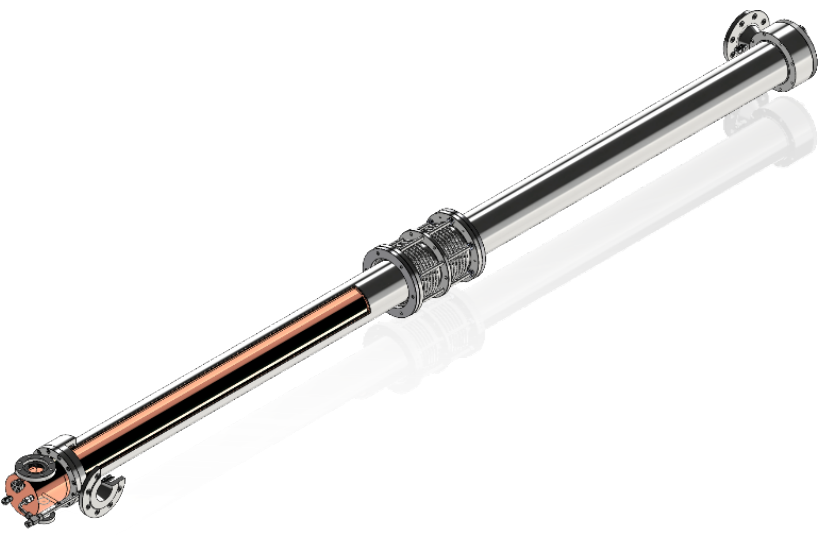
The ITER RF Dummy Load is a high-power dissipation system
designed to safely absorb nearly 1 megawatt of millimeter-wave radiation
generated by the fusion reactor’s gyrotron sources; image above shows full assembly in isometric view. Operating at 170 GHz,
the load receives electromagnetic power through a specialized waveguide and
redirects it off a precision-machined 45° wave profile input mirror. This mirror shapes
the incoming wave profile and routes it into the long absorption tube. Inside
the tube, a high-reflectivity end mirror bounces residual RF energy back
and forth along the length of the structure, forcing multiple passes through an
inner TiO₂-based coating. Each pass converts more RF energy into heat,
allowing the coating to safely dissipate massive power densities without
damage. Ultimately, the system must maintain mechanical stability, vacuum
integrity, and cooling performance throughout long-pulse, high-power operation.
To handle extreme thermal gradients, the load incorporates:
- a mid-body
expansion joint to accommodate structural growth
- active
water-cooling channels running the length of the assembly
- full-penetration
vacuum welds on every joint
- complete
vacuum compatibility and leak-tightness requirements for ITER
hardware
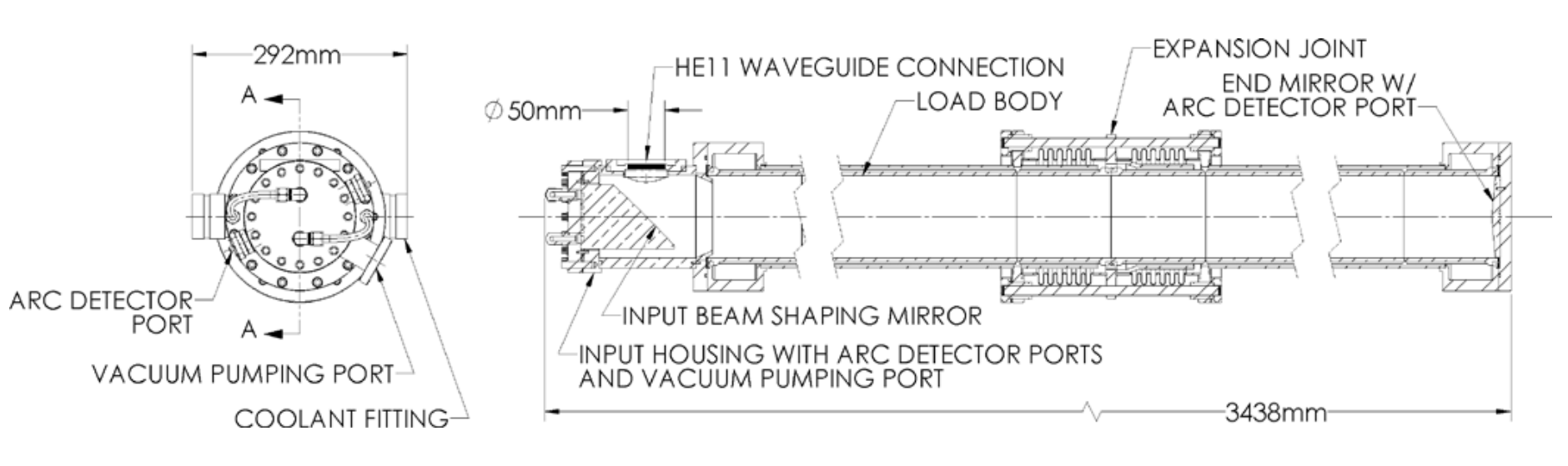
Below demonstrates a more detailed visual of the RF Load Internals disscussed.
I contributed to multiple stages of the prototype
fabrication, inspection, and test-readiness phases:
Metrology & Manufacturing Validation
- Performed
CMM inspections on critical components to verify machined geometry,
flange alignments, and weld-prep surfaces.
- Conducted
root-cause analysis (RCA) to identify deformation arising from
welding, machining sequence, and mechanical distortion during prototype
fabrication.
- Helped
verify that all components met ITER’s stringent tolerances and vacuum
hardware requirements.
Assembly & Integration
- Supported
mechanical assembly of the load structure, including alignment of
the 45° input mirror, end mirror, expansion joint, spot-weld prep, cooling-path routing, and
installation of vacuum-rated seals.
- Assisted
with fixture handling, lifting operations, fabrication and install of RF Load stand with external water and vacuum peripheral attachments, and final packaging for
international shipment.
High-Power Testing Support
- Prepared
the load for long-pulse RF testing at the Swiss Plasma Center (SPC) in
Lausanne (Switzerland).
- Test
conditions reached 800 kW, 10-second pulses, during which:
- thermal
stabilization occurred within the pulse duration
- vacuum
pressure remained stable
- RF
measurements showed low reflection, confirming proper absorption
behavior
These successful tests validated the integrity of the absorber design, thermal performance, vacuum weld quality, and internal TiO₂ coating absorption characteristics.
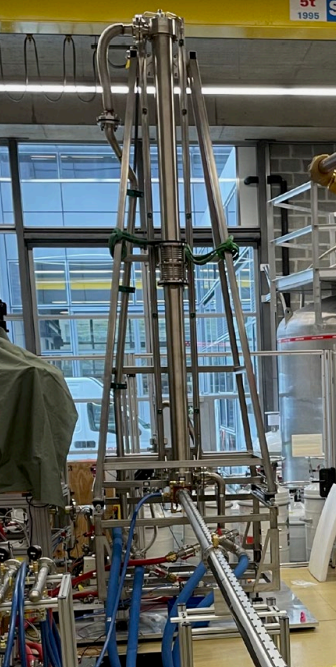
RF Load being at Swiss Plasma Center (SPC) during high power long pulse testing.