Problem Statement – KneeVolve: Smart Rehabilitation Knee Brace
Knee injuries are among the most common musculoskeletal issues affecting athletes, workers, and aging individuals, often leading to prolonged recovery periods and limited mobility. Traditional knee braces provide only passive support, lacking the capability to actively assist in rehabilitation, monitor recovery progress, or adapt to individual user needs. As a result, patients often rely heavily on frequent in-person physiotherapy sessions, incurring high treatment costs and inconsistent recovery outcomes. The challenge was to redesign the conventional knee brace into a smart, accessible, and cost-effective rehabilitation device that integrates real-time monitoring, active therapy, and user comfort. The solution needed to address three key pain points:
1. Limited accessibility and affordability of physiotherapy treatments.
2. Lack of feedback mechanisms in current braces to guide recovery.
3. Poor adaptability, comfort, and sustainability of traditional brace designs.
KneeVolve aims to bridge this gap by creating an intelligent knee brace that not only supports joint stability but also enhances recovery through integrated therapies and smart data-driven insights, making rehabilitation more efficient, affordable, and personalized.
Bill of Materials

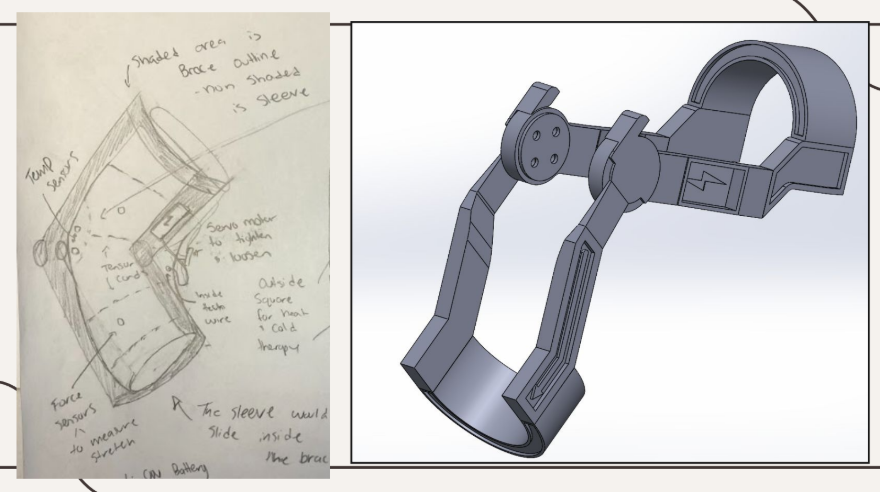
Redesign Proposal The first iteration of the Kneevolve brace was created to display a simple frame of a knee brace, with half circles to support both the upper and lower leg, acting as a skeleton for the straps to connect to and from. The idea is to support the knee by snugly fitting the thigh or calf and providing a stable base. The joint replicates a knee’s natural movement while also limiting its range of freedom to 130 degrees, making sure that the knee will never bend inwards. Its maximum length when deployed is 56.75 centimeters and 2 cm of maximum thickness, this particular model is customized to someone with a 9.7 cm knee width and a 12.5 cm leg width. This initial design would serve as the building block for future iterations. The initial design had to account for fitting and reasonable adjustments to one’s knee. The ‘Cup’ was created to cup around the user’s thigh and calf, each would be user specified before manufacturing. 

Brace Dimensions

Second Iteration